Advertisements
A beginner printer should print viral models well on day one, without hours of tuning. Compare the main options below, then grab the free starter files on the next page.
You will stay on this site. No payment or sign-up required.
Buying your first 3D printer is easier than it was a few years ago. Most popular models now calibrate themselves, print several times faster than older machines and come with ready-made profiles. The right choice depends on what you want to print, how much space you have and whether you want color.
What matters most in a beginner 3D printer
- Automatic bed leveling and calibration: the number one feature for avoiding failed first layers.
- Speed: CoreXY and modern bed-slinger printers finish toys and household parts in a fraction of the time.
- Open frame or enclosed: open frames are cheaper and fine for PLA and PETG; enclosures help with ABS/ASA and keep noise and fumes in.
- Multicolor option: systems like Bambu Lab’s AMS or Prusa’s MMU switch filaments automatically.
- Community and support: popular printers have more profiles, spare parts and troubleshooting guides.
FDM or resin?
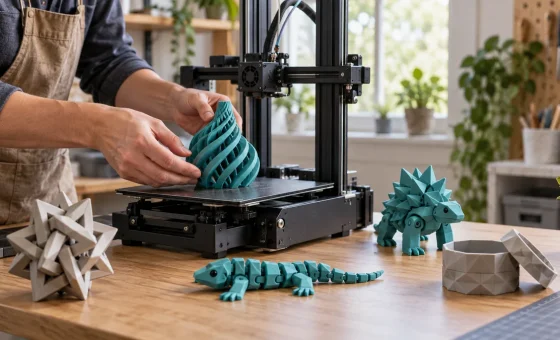
FDM printers melt plastic filament and are the best fit for toys, household parts and the viral prints you see on social media. Resin printers cure liquid resin with light and produce incredibly fine detail for miniatures and jewelry, but they need gloves, ventilation and post-processing. For a first printer, most makers start with FDM.
Popular beginner printers compared
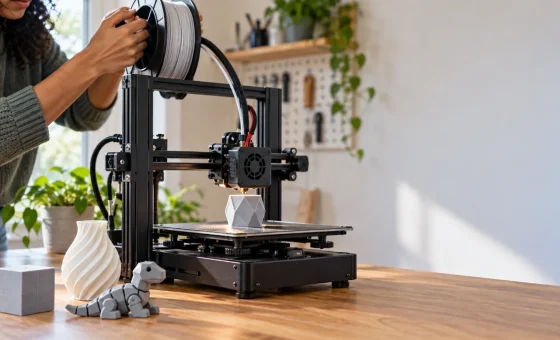
- Bambu Lab A1 mini / A1: open-frame, very easy setup with automatic calibration, and an optional AMS lite for up to four colors. A favorite first printer for viral and multicolor prints.
- Bambu Lab P1S: enclosed and fast, a step up for people who want to print ABS/ASA or run long prints in a closed box.
- Prusa MK4S / Core One: known for reliability, excellent support and open-source software; a strong choice for tinkerers.
- Creality K1C / Ender-3 V3: fast printers with a large community; the K1C is enclosed and handles carbon-fiber filaments.
- Elegoo and Anycubic resin printers: the usual starting point if you mostly want miniatures.
Filament for your first prints
- PLA: easiest to print, great colors, ideal for toys and decor.
- PETG: tougher and more heat- and water-resistant, good for kitchen and outdoor parts.
- TPU: flexible, for phone cases and grips (print slowly).
- Silk and dual-color PLA: the shiny look you see in fidget videos.
Your first week with a new printer
Start with a calibration print, then a simple print-in-place toy, then something useful for your home. That order teaches you the slicer, the first layer and supports without wasting filament. The next page has a free starter pack that follows exactly this path.
FAQ
What is the easiest 3D printer for a complete beginner?
Printers with automatic calibration and ready profiles, like the Bambu Lab A1 series, are the most beginner-friendly. Prusa and Creality also have easy models with big communities.
Do I need to know 3D modeling?
No. Millions of free models are ready to download. You can learn simple design later with free tools like Tinkercad.
Is 3D printing expensive to run?
A 1 kg spool of PLA prints dozens of small toys or household parts. Electricity use is modest for most hobby printers.